 Skip to content

*BREWING*
Brewing Japanese Tea - Prologue
Brewing tea can be as casual as dropping a tea bag into hot water or as formal as the Japanese Tea Ceremony. If you start with good quality tea, it only takes a little care and attention to have a great tea experience. The care and attention are focused on the brewing parameters, water temperature and steeping time. So, here is information on how brewing parameters impact the taste of tea, and some tips to help you brew a better cup. Please consider these as starting points, not as hard and fast rules for brewing. As you brew your favorite tea, make a note of the taste and aroma and adjust the next brewing to suit your taste better.
Brewing System
The taste of Japanese green tea is considered a harmony of fresh bitterness and natural sweetness, also called Umami. The bitterness comes from catechins and caffeine, and Umami comes from L-Theanine, an amino acid.
| Taste of main components chart: | |
| Component | Taste |
| Polyphenol (mainly Catechins) |
Astringency Bitterness |
| Amino acid (mainly L-Theanine) |
Sweetness Body |
| Caffeine | Bitterness |
The relationship between water temperature and the extent that the 3 major components are extracted are key parameters affecting the taste. Catechin and caffeine are more easily extracted with hot water, while L-Theanine extraction is relatively constant regardless of water temperature.
Amount of component dissolution by water
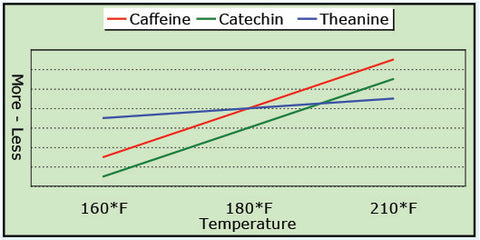
The flavor of the cup you brew depends on how you extract L-Theanine (Umami), that is, how you control the bitterness by adjusting water temperature. Many people say that green tea should be brewed at a low water temperature (160°F to 180°F) to control the bitterness. This is correct for some teas, but it does not apply to all green teas. For example, premium teas like Gyokuro or a high-quality Sencha contain a lot of L-Theanine and are enjoyed mainly for their sweet and full-bodied taste. So, you use a low water temperature to control the bitterness. Genmaicha, Kukicha, and Houjicha are teas where you want to enjoy the aroma as well as the taste, similar to oolongs and black teas. For these teas, use hotter water to extract as much aroma as possible.
| Japanese Green Tea Brewing Parameters – Summary | |||
| Water Temp. | Aroma | Taste | Steeping |
| High | Strongly Aromatic | Flavorful, with a slight bitterness | Short |
| Low | Mildly aromatic | Full bodied, with little bitterness | Long |
Adjusting Water Temperature Without A Thermometer
The best method to reach the desired temperature for brewing is to bring the water to a boil then let it cool to the desired temperature. One way to do this without a thermometer is to pour boiling water into the teacups to be used. The temperature of boiled water cools to approximately 180°F when you pour it into a cup at room temperature. If you transfer the water to another cup, the temperature cools by another 20°F and you have the water at 160°F. By doing this, you can have water at 180°F, 160°F or 140°F as suggested in our brewing instructions. This method also warms the teacup so the tea will stay warm longer.

Water temperature is approximate and varies depending on room temperature.
Brewing Techniques
Gentle Brewing
Gentle Brewing: Gentle Brewing is used for teas where flavor is slightly more important than the aroma. The goal is to draw out the taste from the leaves by using water that is not too hot. This is the technique for any tea that uses water below the boiling point. This brewing method is described in this video:
Robust Brewing
This type of brewing is used for more aromatic teas. Here the aroma is an important part of enjoying the tea. Water is boiled and poured directly onto the tea in the pot as described here:
Making Matcha
Matcha is a fine powder made from tea leaves. The powdered leaf doesn't dissolve in the water, but is suspended in the liquid. Consequently, it is important to enjoy this drink before the tea settles to the bottom of the cup. To help prevent lumps, we recommend that you sift the Matcha through a fine strainer before whisking. Brewing Matcha is very different than steeping tea leaves. You should have at least one special tool, a bamboo whisk called a Chasen. Matcha brewing is described here:
Tips for Brewing
Multiple cups
If you are brewing more than two cups, say 3 cups, the order of pouring is 1, 2, 3 then 3, 2, 1 then 1, 2, 3 and you should make at least 3 pours in each cup. This way, each cup has an equal taste. Even for brewing only one cup, do not pour the tea from the pot in one constant pour. Break up the pour into at least 3 segments just as if you were pouring for multiple cups. Your cup will have a deeper taste because the repeated up and down motion causes the tea leaves and water to mingle more. This brewing tip can be seen here:
Fukamushi Sencha
Fukamushi Sencha is a sencha that is steamed more than normal senchas in the manufacturing process. Consequently, the fibers in the leaves are broken more and it is an “easier” brew. Additionally, you can adjust the cup strength by your pouring action. Even with the same amount of tea leaves, water and infusing time, how you move your teapot makes a difference in your Fukamushi Sencha! You can see the difference here:
We’re not suggesting one method over the other. Just pointing out a way to brew a stronger cup so that you can enjoy Fukamushi Sencha flavor at its maximum. Find your own technique and have the best cup for you.
Water
We suggest using bottled or filtered water for brewing tea. For Japanese green teas where the emphasis is on enjoying the taste more than the aroma, soft water is considered ideal since it is easily absorbed by tea leaves and extracts the rich contents of the tea to the maximum level. Generally soft water has under 100 ppm of calcium or magnesium. Soft water is used to brew most teas in Japan.
On the other hand, hard water is considered good to extract aroma and suppress bitterness. Therefore, hard water is ideal for Genmaicha, Houjicha or flavored tea. The water supplied to homes in North America is mostly hard water.
Normally you don’t need to think about water hardness when you brew tea, however as your taste for Japanese green tea matures you may taste a difference when using soft water.
Iced Tea
Any variety of green tea will make a good glass of iced tea. To add to the refreshing taste, we suggest a tea with a strong aroma. For Japanese teas, Genmaicha, Bancha, Houjicha and flavored senchas are great choices. Steep as directed for hot tea. Once brewed, immediately pour the tea into a cup filled with ice. The rapid cooling locks in the aroma. If you sense the taste is a bit light, use up to 50% more tea leaves than recommended in the Brewing Parameters. This way the brewed iced tea will retain its flavor even as the ice cubes in glass melt.
Additional Tea Tips
You can generally get two infusions from each pot. Be sure to empty the pot of all liquid after the first brewing. This will help avoid the second cup becoming too bitter. Follow the directions on the package for the second brewing as the steeping time and temperature may vary.
Keep your tea ware clean. Remove any stains that start to appear. If necessary, use bleach to clean hard-to-remove stains. (Be sure to thoroughly rinse the pot after using bleach.) The spout of the pot is sometimes neglected in the cleaning process so pay special attention to it.
Storing Tea
For unopened packages of tea, we recommend that our products be stored in the refrigerator or, even better, the freezer. Our 1 lb loose leaf packages are vacuumed sealed and are good for 12 months in the refrigerator. Our 2 oz packages have an oxygen absorber to keep the tea fresh until opened and are also good for 12 months. Once the package is opened, please discard the oxygen absorber.
After opening, reseal the package well after use. (Our 2 oz package is re-sealable.) Then store it in your refrigerator. Please note, taking open packages in and out of the refrigerator frequently may cause the tea to absorb moisture that harms the quality of the tea. After opening a package, we suggest you consume it in a few months to enjoy the freshest tea. Tea is a very stable product and you can drink it up to a year after opening. After a year, the tea is still drinkable but you most likely will notice a change in its quality and flavor. We don't recommend to store tea in glass jars since the light will impact the color and quality of the tea.
Brewing Related Questions
A: 1 teaspoon is 2 grams. So you can have 28 cups of a single serving. Usually you can brew a second flavorful cup of tea from the one teaspoon. Using 2 grams is general rule and you may use more or less depending on your flavor preferences.
A: Our tea bag brewing instructions suggests "30 seconds" and that is considered general rule for green tea. However, there is no hard and fast rule; it's personal preference. Den actually leaves the bag until he finishes the cup exactly like you. It is simply because he likes a strong cup of tea. It takes longer to get the tea strong enough for him with the hard water in the US than soft water in Japan. Please enjoy however it tastes the best for you.
A: You can brew cold brew iced tea with hot water. It is not a problem and actually it is very good because the tea leaf used for cold brew is very high quality and designed to infuse quickly.
A: We recommend 180-195 degrees and 15 seconds for Sencha and 160-175 degrees and 30 seconds for Gyokuro. The higher water temperature makes a cup slightly more bitter or fresher. Please adjust temperature and time to your preferred taste.
A: We usually advise up to 2 infusions and Den usually follows the guideline. You can go beyond two, but of course, the tea will get weaker.
A: The "best" brewing method for iced green tea depends somewhat on your situation. There are two methods, hot brewing and cold infusion. I'll describe both methods and their benefits, and then you can choose the best one for you.
For hot brewing, prepare your favorite tea and use 50% more tea leaves than recommended in the Brewing Parameters. Steep as directed for hot tea. Now, this is the important part, once brewed, immediately pour the tea into a container filled with ice. The rapid cooling locks in the aroma. The longer steeping will brew a more flavorful cup so it will stand up to the ice. This method of making iced tea takes only a little longer than making a hot cup of tea so it is a great spur of the moment treat or when a friend stops in for an unexpected visit.
For cold infusing, you can use loose tea or our cold brew tea bags. Cold infusing with loose leaf tea is especially designed for our premium Sencha and Gyokuro tea. Use the same amount of tea leaves and water as directed for hot brewing, but pour cool water into a teapot. Leave it for at least 10 minutes. You will find an incredible flavor waiting for you; a natural sweetness with absolutely no bitterness. Remember, this brewing method should only be used with premium teas such as Sencha Zuiko, Shinryoku or Gyokuro Suimei. For any other type of tea, the hot brewing method should be used for best flavor. Avoid adding ice to this tea as it will dilute the delicate flavor. This method takes a little longer and is only recommended for premium teas. Cold brew tea bags are an easy way to enjoy refreshing iced green tea. Simply put one or two teabags into water as directed on the package. Stir or shake and put it into the refrigerator for few hours or overnight. The tea leaves in our tea bags are specially cut and processed to infuse in cool water and produce a flavorful glass of iced tea. Using cold brew tea bags is easy, but takes the longest so you need to plan ahead to enjoy this refreshing drink.
A: As you know Matcha does not dissolve in the brewing water but is in a suspension. You can certainly make a second cup with all of our Matcha Blended teas such as Sencha Extra Green. Your first cup will likely contain more Matcha than the second and consequently will be sweeter. The second cup will have more Sencha flavor and is still a wonderful cup of tea.
A: Umami is considered to be the fifth human taste sense rounding out sweet, sour, salt and bitter. Umami refers to the savoriness of glutamine acid, a type of amino acid found in many protein-heavy foods such as meat, cheese, and broth. It is considered the most influential factor in determining how delicious a food is. It is Umami that lets you "feel" the taste of seaweed when you drink Gyokuro.
A: Cold brew tea bags are designed to be used in water that is not heated. You can use water that is anywhere from room temperature to refrigerator temperature. For lower water temperatures, try using a longer infusion time, maybe 2 hours instead of one hour.
A: When water is boiled, it violently collides with each other and the molecules become finer, making it easier for the water to penetrate into the tea leaves. Hot water that has been boiled and then cooled is more suitable for brewing tea.
A: Although we say that boiling water makes it better for brewing tea, there is no scientific data on whether the molecules become even finer if boiled for a long time. However, in the Japanese tea industry, it is generally said that it is better to boil the water for a few minutes.
Brewing Den's Tea - Epilogue
When we started our business in 2000, tea drinkers in North America did not seem ready for the traditional taste of Japanese green tea. Consequently, we developed our brewing parameters to make a slightly lighter and milder cup of tea.
On our 10th anniversary in 2010, we updated our brewing parameters to produce a more traditional and slightly stronger cup because we thought many of our patrons had developed into tea fanatics and were ready for a more full-bodied taste.
In 2020, our 20th anniversary, we updated brewing again to adjust for the maturing tastes of our North American customers. In the past decade, we have seen even more tea fanatics and they have established their own styles. In fact, when we surveyed our customers, we found that most of our customers brew Japanese tea just for themselves and use a 4oz cup for premium tea and an 8oz cup for casual tea. So, we adjusted our brewing parameters again for our changing customer base. Of course, there are many ways to brew tea, however the most important brewing style is the way you like your tea. As we did 20 years ago, we still suggest that you experiment with water temperature and steeping time for each tea that you enjoy and keep notes of the result. You will soon find your personal tea brewing style and that’s the best one for you!